
Creating Productive and Comfortable Workspaces
The modern workplace has changed dramatically. Traditional individual offices have increasingly been replaced by open-plan layouts, collaborative workspaces, shared meeting areas, and flexible working environments.
These changes encourage interaction and create more adaptable workplaces, but they also introduce significant acoustic challenges.
Conversations, telephone calls, video meetings, office equipment, and everyday activities can create a complex sound environment, especially in spaces dominated by glass, concrete, and other reflective materials.
Without appropriate acoustic treatment, these conditions can interfere with communication and make concentration more difficult.
Professional acoustic solutions help create a balance between collaboration, privacy, and individual comfort.
Why Acoustic Comfort Matters in the Workplace
Acoustic comfort is an essential part of a well-designed working environment.
A comfortable workspace should allow employees to communicate clearly without unnecessarily disturbing those around them.
It should also provide suitable conditions for concentration, meetings, telephone conversations, and everyday professional activities.
When excessive reverberation is present, sound reflections can contribute to a persistent background noise problem.
Employees may find themselves raising their voices to communicate, which can further increase the overall noise level.
Reducing excessive reverberation can help improve acoustic clarity and create a more pleasant environment for everyday work.
The Acoustic Challenges of Open-Plan Offices
Open-plan offices often contain multiple workstations without full-height separating walls.
Although these layouts offer flexibility, sound can travel across shared areas while reflecting from surrounding surfaces.
Several acoustic challenges are particularly common.
Conversations Between Workstations
Discussions between colleagues are essential, but speech originating from nearby workstations can become distracting when it remains clearly audible across a large area.
Telephone and Video Calls
Frequent calls can generate overlapping speech and create additional distractions for employees working nearby.
Reflective Architectural Materials
Glass partitions, exposed concrete, hard flooring, and large ceiling surfaces can increase reverberation and make a workspace feel acoustically uncomfortable.
Limited Acoustic Privacy
In open layouts, employees may have difficulty maintaining a sense of acoustic separation between individual workstations.
Addressing these problems requires more than simply adding decorative elements. The acoustic characteristics of the entire space should be considered.
How Sound-Absorbing Panels Improve Office Acoustics
Sound-absorbing panels reduce sound reflections by absorbing part of the acoustic energy that reaches their surfaces.
When correctly selected and positioned, they can improve the acoustic conditions of shared workspaces and help control excessive reverberation.
Different products serve different purposes.
Wall-mounted panels can treat reflective surfaces, while ceiling systems can introduce acoustic absorption without occupying valuable floor space.
Acoustic desk screens can provide local workstation separation and contribute additional absorption near employees.
Combining these solutions often provides greater flexibility than relying on a single installation method.
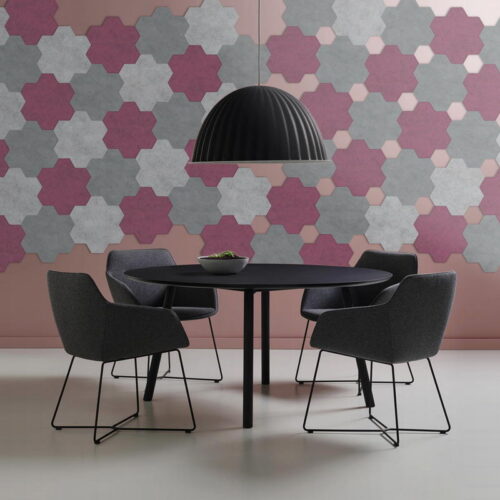
Wall-Mounted Acoustic Panels
Wall-mounted sound-absorbing panels are a practical choice for meeting rooms, collaborative areas, reception spaces, and offices with large reflective surfaces.
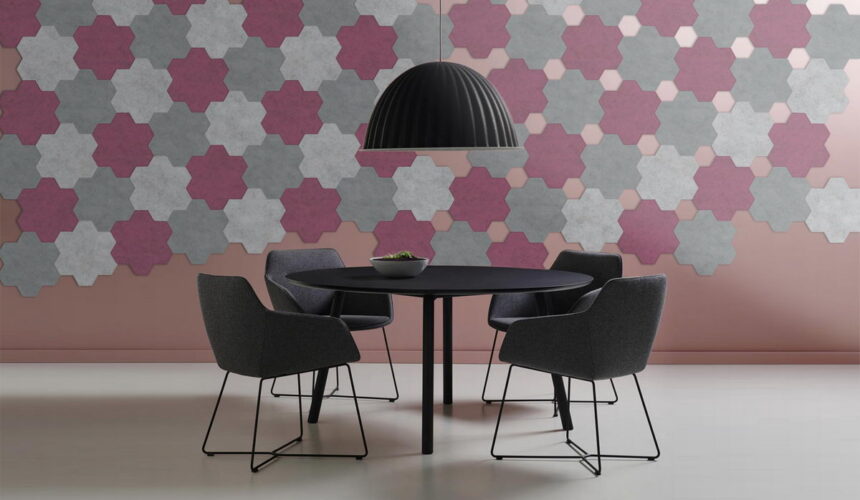
They can be positioned to address sound reflections while also becoming part of the interior design.
ACUSTICO® DECHO® panels offer a combination of acoustic functionality and architectural appearance, making them suitable for different professional environments.
Their visual simplicity allows them to integrate into contemporary offices without disrupting the overall design language.
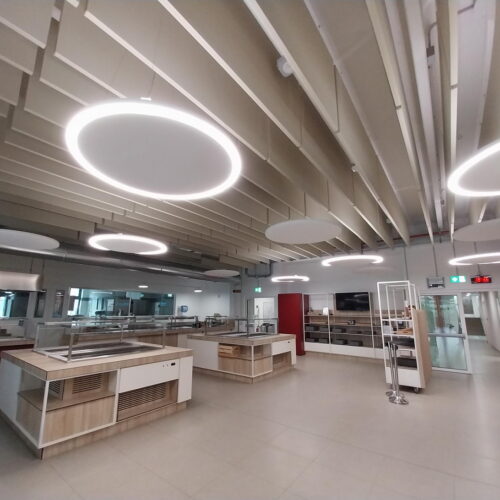
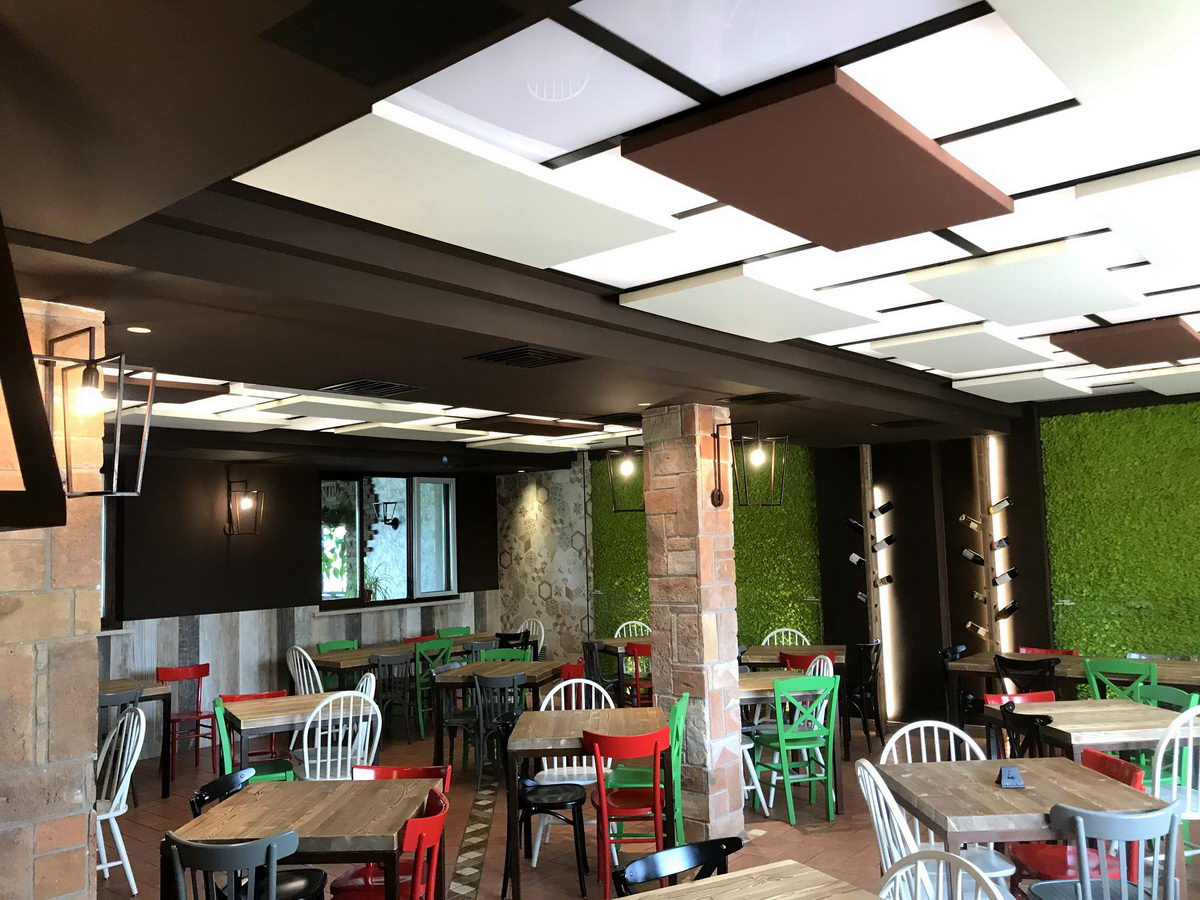
Suspended Ceiling Panels and Acoustic Baffles
Ceiling treatments are particularly useful in open-plan offices, where wall space may be limited by windows, furniture, and architectural features.
Suspended acoustic elements provide additional sound-absorbing surfaces while maintaining an open and spacious interior.
ACUSTICO® DECHO® Baffles are designed for acoustic treatment in environments requiring both technical performance and visual integration.
Depending on the selected configuration, baffles can be mounted close to the ceiling or suspended using dedicated support systems.
These solutions are particularly relevant for large offices, coworking spaces, and reception areas with exposed or high ceilings.
DECHO® Screen: Acoustic Separation for Workstations
In modern offices, individual workstation comfort is becoming increasingly important.
ACUSTICO® developed DECHO® Screen as an acoustic partitioning solution intended for office desks and shared workstations.
Unlike conventional solid partitions that can introduce additional reflective surfaces, DECHO® Screen is designed around sound-absorbing materials and an internal structure that supports acoustic treatment.
The product combines workstation separation with acoustic functionality, helping designers create more defined work areas within open-plan layouts.
It is important to distinguish this type of solution from a fully sound-insulated private room: desk screens can improve local acoustic conditions, but they do not provide complete speech isolation.
Acoustic Design for Meeting and Conference Rooms
Meeting rooms have different requirements from general open-plan offices.
Their primary function is communication, whether through face-to-face discussions, presentations, or video conferencing.
Excessive reverberation can make speech less intelligible, particularly when several participants are speaking or when audio is transmitted through conferencing equipment.
An appropriate combination of wall and ceiling absorption can help control reflected sound and improve communication conditions.
For rooms used frequently for video conferencing, attention should also be given to microphone placement, loudspeaker systems, furniture, and background noise.
Effective acoustic design considers all these elements as part of the same environment.
Combining Acoustic Performance with Office Design
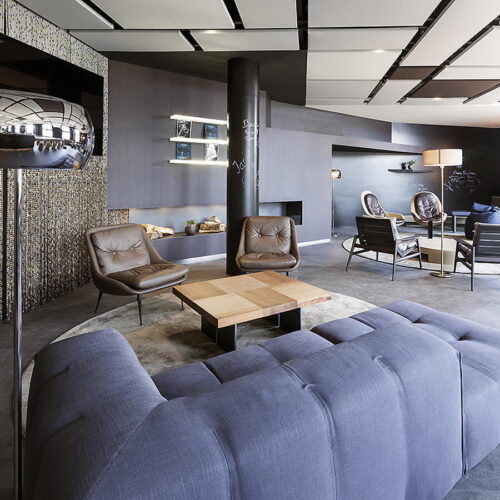
An acoustic solution should support the architectural identity of the workplace rather than appear as an afterthought.
Modern offices often follow a carefully defined visual language involving corporate colors, textures, materials, and geometric shapes.
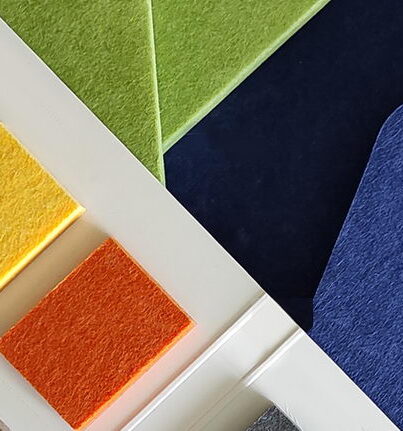
ACUSTICO® offers acoustic products with different aesthetic characteristics, allowing architects and interior designers to select solutions that suit the intended interior.
Circular panels, suspended elements, fabric-covered screens, and decorative wall compositions can be combined to create functional spaces with a distinctive appearance.
The objective is to integrate acoustic comfort into the design process from the beginning.
Planning an Office Acoustic Treatment
Before selecting acoustic panels, it is important to consider how the workplace is used.
An effective assessment should examine room dimensions, ceiling height, surface finishes, furniture, workstation distribution, and typical activities.
The desired result must also be clear.
An open-plan office focused on individual concentration may require a different strategy from a collaborative environment where frequent communication is expected.
For more complex spaces, a professional acoustic evaluation can help determine the appropriate treatment and identify the most effective installation areas.
A Better Working Environment Starts with Better Acoustics
Acoustic comfort is no longer simply a technical consideration. It is an important component of workplace quality and thoughtful architectural design.
By reducing excessive reverberation and introducing appropriate acoustic separation, organizations can create spaces that better support communication, concentration, and everyday professional activities.
With solutions such as DECHO® panels, DECHO® Baffles, and DECHO® Screen, ACUSTICO® combines technical acoustic expertise with Italian design.